

 INTRODUCTION- If you enjoy poker, you may be familiar with Texas Hold 'em due to the games exposure on tv, online and in popular culture.
Texas Hold 'em is more involved than Blackjack and appeals to gamblers who want more interaction between players. Below, are basic play instructions. If more detailed information is required, search for Texas Hold 'em rules online.
NOTE TO THE PURISTS- As with Blackjack, I have changed the real betting format of the Hitchiker version of Texas Hold'em, primarily to speed things up and assist the novice player in understanding what to do.
OVERVIEW- In Texas Hold 'em, as in other games of poker, players compete for money contributed by the players themselves (called the pot). As a bonus, in the Hitchiker version the bank also seeds the game with an additional $100,000 to get started.
Players attempt to control the amount of money in the pot based either on the their own hand, or on their prediction as to what their opponents may be holding.
The hand is divided into a series of stages; at the conclusion of which, the pot is typically awarded to one player (an exception discussed below).
A hand may end at the showdown, in which case the remaining players compare their hands and the highest hand is awarded the pot; that highest hand is usually held by only one player, but can be held by more in the case of a tie.
The other possibility for the conclusion of a hand occurs when all but one player has folded and have thereby abandoned any claim to the pot, in which case the pot is awarded to the player who has not folded.
The object of game is to make mathematically and psychologically correct decisions regarding when and how much to bet, raise, call or fold.
Reminder, Hitchiker rules vary from reality.
The game begins when a player has landed on any CASINO and indicates they want to play Texas Hold 'em as their gambling game.
ANTE UP TO BEGIN- The pot is initially seeded with a $100,000 contribution from the bank. Each player who wishes to play the game must then put in a forced contribution to the pot known as an "Ante" of $10,000.
DEALING THE STARTING HANDS- Play begins with each player being dealt two cards, FACE DOWN with the player on the left of the Dealer receiving the first card. These cards are the "Hole" or "Pocket" cards.
NOTE:There is no pre-flop round of betting.
Next, the Dealer deals the "Flop" which are 3 cards FACE UP (community cards) which all players can use to eventually make a hand in combination with any or none of their hole cards.
The flop is followed by a round of betting. All betting rounds begin with the player to the dealer's left and continue clockwise.
BETTING- This is no limit Texas Hold'em. The minimum allowed bet is $10,000 (equal to the ante) and there is no maximum, you can bet all of your travelling cash if you choose. Player's can call an all-in bet with all of their travelling cash even if it's less. This may create a side pot if more than two players are involved.
When it is a player's turn to act, the first verbal declaration or action he takes binds him to his choice of action; this rule prevents a player from changing his action after seeing how other players react to his initial, verbal action.
Until the first bet is made each player in turn may "check," which is to not place a bet, or "open," which is to make the first bet.
After the first bet each player may "fold," which is to drop out of the hand losing any bets they have already made; "call," which is to match the highest bet so far made; or "raise," which is to increase the previous high bet.
A player may fold by surrendering his cards. A player may check by tapping the table or making any similar motion, or verbally saying "Check". All other bets are made by placing chips in front of the player, but not directly into the pot("splashing the pot" prevents other players from verifying the amount bet).
To raise is to increase the size of the bet required to stay in the pot, forcing all subsequent players to call the new amount if they wish to remain in.
Standard poker rules require that raises must be at least equal to the amount of the previous bet or raise. For example, if an opponent bets $10,000, a player may raise by another $10,000 (or more), but he may not raise by only $5,000.
TIP: Players are expected to keep track of the betting action. Losing track of the amount needed to call, slows the game down and pay attention if you're in a hand.
All actions (calls, raises or folds) must be taken in turn. To do otherwise provides information that should not be available to the other players.
CONTINUING ON ...
After the post flop betting round ends, a single community card (called the turn or fourth street) is dealt, followed by a second round of betting.
A final single community card (called the river or fifth street) is then dealt, followed by the third and final round of betting and the showdown, if necessary.
THE SHOWDOWN
If a player bets and all other players fold, then the remaining player is awarded the pot and is not required to show his hole cards. If two or more players remain after the final betting round, a showdown occurs.
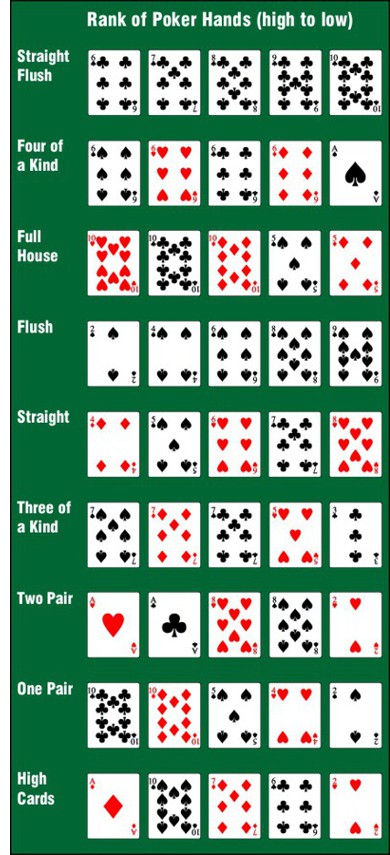
On the showdown, each player plays the best poker hand they can make from the seven cards comprising his two hole cards and the five community cards. A player may use both of his own two hole cards, only one, or none at all, to form his final five-card hand.
If the five community cards form the player's best hand, then the player is said to be playing the board and can only hope to split the pot, because each other player can also use the same five cards to construct the same hand.
If the best hand is shared by more than one player, then the pot is split equally among them, with any extra chips going to the first players after the button in clockwise order.
It is common for players to have closely valued, but not identically ranked hands. Nevertheless, one must be careful in determining the best hand; if the hand involves fewer than five cards, (such as two pair or three of a kind), then kickers are used to settle ties (next best cards in the player's hand).
Note that only the card's numerical rank is important, suit values are irrelevant in Hold'em. The last player to bet is the first player to show his hand.
SIDE POTS- A side pot occurs when one player is "all-in", and at least two players with money are still in the hand, and continue the betting. For example::
- Player A has $50,000
- Players B and C both have $100,000
Player A goes all-in after the flop. Both players B and C call. There are now $150,000 in the main pot (plus the seed money and antes).
After the turn comes out, Player A can do nothing because he is all-in. It is possible for both players B and C to check the turn, and river, and then all 3 players would turn their hands over, and the best hand would take the main pot.
However, if either player B or C make any bets on any street after the flop, that money goes into a side pot that is solely contested by them.
Player A can win no more than the main pot so any amount player B or C bet after Player A is "all-in" creates a side pot that only B or C can win.
The best hand out of all 3 of them still always wins the main pot.
If player B or C bets and the other one folds, the one who folds forfeits his chance to win the main pot.